
Research Article
Received: 2026-03-22 | Revised:2026-04-05 | Accepted: 2026-04-08 | Published: 2026-05-19
Pages: 23-34
DOI: https://doi.org/10.56717/jpp.2026.v05i01.050
Abstract
Proper wound healing is important for restoring in the
skin's protective function and morphological consistency. The rise in antimicrobial resistance in
wound-infecting bacterial strains is a significant threat, but it has
necessitated the current quest for sourcing new antimicrobial agents from
plants, such as the castor bean plant. Ricinus communis oil was obtained by evaporating
the solvent from the filtrate of the maceration of pulverized castor beans in
hexane. Nanoemulsions were prepared with the oil and characterized based on the
mean particle size, polydispersity index, and viscosity. The oil and nano-emulsions
were evaluated for their antimicrobial susceptibility. The nanoemulsion was used
to produce nanocreams (F1-F4), which were evaluated for their physicochemical,
antimicrobial and wound healing activities. The extracted oil was similar to the reference
standard oil (density of 0.93 g/mL and refractive index of 1.4754). Stable
nanoemulsions having average particle diameter and polydispersity index of
72.30 nm and 0.222, respectively, were obtained. The nanocreams, particularly formulation 1 (F1),
demonstrated significantly superior antibacterial activity against organisms such
as Staphylococcus aureus and Escherichia coli compared to oil or nanoemulsion. In the wound
healing studies, F1, like the positive control (gentamicin cream) achieved
complete wound closure by day 12, and significantly accelerated repair compared
to the negative control. No signs of skin irritation were observed. The nanocreams exhibited desirable characteristics, including
skin-friendly pH (5.74 ± 0.40 - 6.5 ± 0.10), good spreadability, and a shear-thinning
viscosity profile. Ricinus
communis oil-loaded nanocreams with enhanced antibacterial efficacy and accelerated
wound repair were successfully formulated.
Abstract Keywords
Antimicrobial, nanocreams, physicochemical, Ricinus communis, wound healing,
microorganisms.
1.
Introduction
A wound
is a break in the epithelial integrity
of the skin caused by a chemical, physical, thermal, immunological, or
microbial injury, often resulting in both structural and functional disruption.1
Proper wound healing is vital to restore the skin's protective function and
morphological consistency [1].
Wound healing is a sophisticated, highly efficient,
and tightly controlled dynamic cascade
that restores cellular structures and tissue layers [2].
This complex process requires the coordinated interaction of cells in the
dermis and epidermis, blood cells, proteins, growth factors, proteases, and
extracellular matrix components [1, 2]. The
healing process consists of three major, integrated, and continuous phases. The
first is the inflammation phase, which
starts immediately upon injury with vasoconstriction to promote hemostasis, followed by the release of
inflammatory mediators [1]. This phase involves key events such as
chemotaxis and phagocytosis [2].
The next stage, the proliferation phase,
is characterized by the formation of granulation
tissue, angiogenesis, and
epithelization [1].
The generation of new glycosaminoglycans
and proteoglycans is also
essential [2]. The final stage, the remodeling phase, involves the
reformulation and maturation of collagen
fibers to increase the tensile strength of the tissue [1].
This phase includes neocollagenesis,
collagen degradation, and collagen remodeling [1].
The ultimate outcome of this phase is the replacement of the normal skin
structure with fibroblastic-mediated
scar tissue [2].
While acute wound repair typically follows a robust
and rapid path due to the high redundancy and compensation mechanisms of the
biological system, various factors can lead to non-healing or chronic wounds [3]. Failure to heal normally is influenced by internal or systemic factors, such as
age, dehydration, nutritional status, vascular insufficiency, and concurrent
diseases [3, 4], as well as external or local factors, such as
pressure, temperature, wound size, foreign bodies, and bacterial burden [3]. Infection is a major complication, as
open wounds expose underlying tissues to the external environment, increasing
the risk of bacterial and fungal infections [5].
The rise of antimicrobial resistance
in wound-infecting bacterial strains is a growing global public health problem that
increases mortality, morbidity, and treatment complexity due to the high cost
and slow pace of new antibiotic discovery [1, 5].
To address the issue of antimicrobial resistance, there is a current quest for
sourcing new antimicrobial agents from plants and other natural sources [6, 7]. Plant materials are used in traditional
medicine to treat various diseases, including those caused by microorganisms.
Some of these claims have been confirmed by pharmacological studies [8, 9]. These pharmacological effects have been
attributed to the presence of secondary metabolites, such as tannins and
alkaloids, in these plants [7].
Castor oil is a vegetable oil that is produced by pressing the seeds of the castor oil plant (Ricinus communis L.) (Fig. 1). It is composed mainly of ricinoleic acid, a monounsaturated fatty acid, which makes it more polar than other vegetable oils [10, 11]. The oil contains many bioactive substances, such as flavonoids, sesquiterpenes, alkaloids, tannins, triterpenoids, anthrocyanins, phenolics and vitamins that produce antioxidant, antimicrobial and astringent activities needed for its wound healing capacity [12]. It serves as a natural moisturizer, and its anti-inflammatory and analgesic activities relieve pain and inflammation, while tissue repair is accelerated by its wound-healing effects [11]. Reports from excision wound healing models confirmed the wound healing activity of castor oil, which is due to its ability to reduce lipid peroxidation and its antioxidant action, such as enhancement of collagen fibril viability, collagen fibre strength, elevation of blood circulation, DNA synthesis, and prevention of cell damage [12].

Figure 1. Ricinus communis (a) plant
(b) seeds.
Herbal medicines usually have the disadvantage of
poor aqueous solubility, stability and bioavailability issues owing
to their composition of
different components, large molecular size, and susceptibility to degradation [13]. This is usually resolved by the application
of novel drug delivery systems, such as nanotechnology, which provides
increased aqueous solubility, sustained release, lower toxicity, targeted drug
release and stability [4]. Novel drug
delivery systems include nanoemulsions, niosomes, liposomes, solid lipid
nanoparticles, phytosomes, polymeric nanoparticles, metal nanoparticles and
dendrites. They significantly improve phytoconstituent solubility and
bioavailability, provide protection against physical, chemical, and enzymatic
degradation as well as modify drug release characteristics [14].
Nanoemulsions
are clear, transparent, and stable
biphasic isotropic systems with tiny particle sizes ranging from 20 to 200 nm [5, 14].
Emulsion-based systems are categorized into three main types based on their
composition: oil-in-water (o/w),
water-in-oil (w/o), and multiple emulsions [14].
Nanoemulsions are highly versatile and can be formulated in various delivery
forms, including oils, creams, gels,
sprays, aerosols, and foams. This versatility allows for uniform
administration through numerous routes, including topical, intravenous, intranasal, pulmonary, ocular, and dental [15].
Creams are semisolid emulsions intended for external application to the skin
or mucous membranes (such as the rectum or vagina). Characteristically, creams
are opaque, semisolid emulsions or viscous liquids. They exist in two main varieties:
water-in-oil (w/o) and oil-in-water (o/w) [16,
17]. The rheological behavior and consistency of a cream are
dictated by its specific emulsion type (o/w or w/o) and the composition of the
dispersed solid phase [18]. Creams are
commonly used because of their simple and non-invasive method of application,
as well as their comfort for the patient. It is suitable for formulations that
contain oil as the active ingredient because it protects it, enhances its
stability, as well as improves its dispersion in water [19]. These properties can be further enhanced by nanotechnology.
Making the creams as nano-sized droplets (nanocreams) will improve its
penetration into the skin as well as improve its efficacy [19, 21]. Nanocreams are semisolid dosage forms in
the form of stable emulsions with droplet size of 20-500 nm in diameter [20]. The minute size provides uniform and smooth
deposition of cream onto the skin surface as well as enables the active
ingredients to permeate the stratum corneum and improve skin penetration [19, 21, 22]. Previous studies shown that nanoemulsion-based creams offer improved skin
permeation, superior bioactive delivery, and stable performance, making them promising
candidates for topical skincare and antimicrobial applications [22]. The stability of nanocreams is affected by surfactant selection,
surfactant concentration, and the Hydrophile-Lipophile Balance (HLB) value [19]. Nanocreams are prepared using high-energy
techniques like ultrasound generators, high-pressure homogenizers, or high
shear stirring [21].
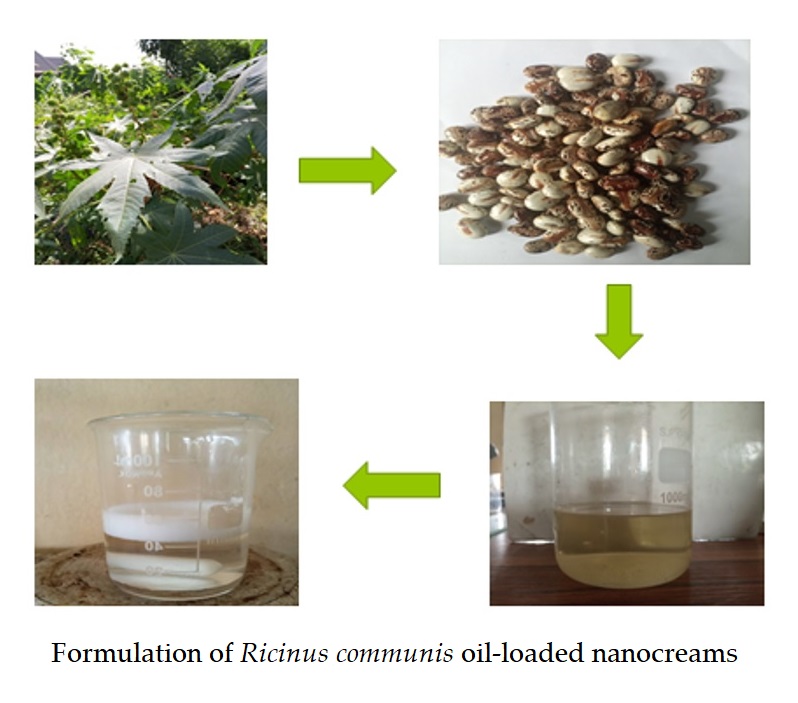
In this study, castor oil was formulated into nanoemulsions and incorporated as the aqueous phase to prepare nanoemulsion-based cream (nanocreams) to enhance the targeted release of a more soluble form of castor oil at the wound site, as well as improve its permeation across the skin. This leads to enhanced wound healing activity. This study aimed to determine the antimicrobial and wound-healing properties of castor (Ricinus communis L) oil and nanocreams formulated using Ricinus communis L. oil.
2. Materials and methods
2.1. Materials
The materials used include hexane (CDH, India), polyethylene glycol 200 (LOBA, India), Tween 80 (Guangdong Chemical, China), nutrient agar, Muller Hinton agar (Titan Biotech, India), Sabouraud dextrose broth (Life Save biotech, USA), amaranth solution, liquid paraffin, glycerol, stearic acid, cetostearyl alcohol, methyl paraben, propyl paraben (Tianjin Kermel, China), ciprofloxacin infusion (Fidson, Nigeria), Nystatin suspension (Advacare Pharma) and Gentamycin ointment (Drugfield, Nigeria).
2.2. Organisms used
Staphylococcus aureus, Lactobacillus, Escherichia coli, Proteus vulgaris, and Candida albicans were obtained from the stock preparation of the Department of Pharmaceutical Microbiology and Biotechnology, Faculty of Pharmacy, Delta State University, Abraka.
2.3. Collection and identification of plant material
Castor beans were collected from the farm attached to the medicinal plant garden of the Department of Pharmacognosy and Traditional Medicines, Faculty of Pharmacy, Delta State University, Abraka. It was identified by Dr. Akinnibosun Henry Adewale of the Department of Plant Biology and Biotechnology, Faculty of Life Sciences, University of Benin, Nigeria. It was assigned voucher number UBH-R391.
2.4. Extraction process
The Castor beans were sun-dried for 3 days and further dried in the oven at 60°C for 7 h in order to reduce the moisture content. The samples were then deshelled and winnowed using a tray. The samples were pulverized using a hand grinder [23]. A 550 g quantity of the milled castor beans was macerated and stirred occasionally in 700 mL of hexane for three days. It was then filtered using a clean muslin cloth, and the filtrate was centrifuged at 3000 rpm for 30 min. The supernatant was kept in the oven at 70 °C for 7 h to evaporate the remaining hexane [24].
2.5. Antimicrobial studies
2.5.1. Preparation of overnight broth culture
A 0.8 g of Sabouraud dextrose agar and 1.8 g of nutrient agar were dissolved in 20 and 100 mL of water, respectively and transferred into different test tubes. Thereafter, the test tubes were sterilized in an autoclave at 121 °C for 15 min and left to cool after sterilization. The broth media were then inoculated with the appropriate organism using a sterilized wire loop. Candida albicans (fungus) was inoculated into the test tube containing Sabouraud dextrose broth and the bacteria (Staphylococcus aureus, Lactobacillus, Escherichia coli and Proteus vulgaris) were inoculated into the nutrient broth. They were incubated at room temperature for 48 h for the fungus and at 37 °C for 24 h for the bacteria.
2.5.2. Antimicrobial sensitivity testing using standard agar diffusion method
Sterilized Muller Hinton agar and Sabouraud dextrose agars (20 mL each) were poured into sterile Petri dishes and allowed to solidify. Each agar plate was inoculated with a different organism (Muller Hinton for bacteria and Sabouraud for fungi). Thereafter, 6 wells of 6 mm in diameter were aseptically bored into each of the agar plates with a cork borer and the wells were labelled according to their concentration (100%, 50%, 25%, 12.5%, 6.25%, and 3.125%). One well was made in the middle for positive control (ciprofloxacin 20 mg/mL for bacteria and nystatin suspension 100 UI/mL for the fungus). After labelling, various concentrations of castor oil were aseptically added to their respective wells using a Pasteur pipette according to their labelled concentrations (methanol was used as the diluent). The plates containing the bacteria-inoculated samples were incubated at 37 °C for 24 h in an incubator and the zones of inhibition were measured. The plates containing the fungal inoculum were wrapped in aluminum foil and kept at room temperature for 48 h to grow. After 48 h, the zones of inhibition were measured and recorded.
2.5.3. Preparation of Ricinus communis nanoemulsions
A burette was clamped to a retort stand and filled with distilled water to the zero mark using a funnel. The surfactant and co-surfactant (tween 80 and polyethylene glycol-200 respectively) were mixed (surfactant-mix) at different mass ratios (1:1, 1:2, 2:1 and 3:1) and different concentrations of the surfactant-mix and oil (1:1, 2:1, 3:1, 4:1 and 5:1) were also prepared in a beaker mounted on a magnetic stirrer [25]. Slow titrations with the aqueous phase were performed with mass ratios of the Surfactant-Mix and oil and continuous stirring to obtained a transparent emulsion. A transparent nanoemulsion was obtained at a surfactant-mix ratio of 30:1 and surfactant-mix to oil ratio of 2:1.
2.5.4. Preparation of Ricinus communis nanoemulsion creams
A 3.0 g quantity of stearic acid was weighed, transferred into a porcelain dish and melted at 70 °C in a water bath. A 1.2 g quantity of cetostearyl alcohol, 0.03 g of propyl paraben and 4.29 mL (3.6 g) of liquid paraffin were added and mixed properly to form the oil phase. A beaker containing 42.95 g of nanoemulsion, 4.95 mL (5.35 g) of tween 80, 0.27 g of methyl paraben, and 3 mL (3.6 g) of glycerol were stirred and heated at 70°C with a magnetic stirrer with hot plate as the aqueous phase. The oil phase was gradually added gradually to the aqueous phase at 70°C and stirred for 5 min. The heat was then turned off, and the mixture was allowed to cool while stirring. It was then transferred into a cream jar and labelled appropriately. The other formulations were prepared according to the formula shown in Table 1.
Table 1. Composition of Ricinus communis oil loaded nanocreams.
Ingredients | F1 | F2 | F3 | F4 |
Liquid paraffin (g) | 3.60 | 3.60 | 3.60 | 3.60 |
Tween 80 (g) | 5.35 | 5.35 | 5.35 | 5.35 |
Stearic acid (g) | 3.00 | 3.00 | 3.00 | 3.00 |
Cetostearyl alcohol (g) | 1.20 | 4.80 | 1.20 | 1.50 |
Methyl paraben (g) | 0.27 | 0.27 | 0.27 | - |
Propyl paraben(g) | 0.03 | 0.03 | 0.03 | - |
Glycerin (g) | 3.60 | 3.60 | 3.60 | 3.60 |
Nano-emulsion (g) | 42.95 | 42.95 | - | 42.95 |
Water (mL) | - | - | 42.95 | - |
2.6. Physicochemical evaluation of Ricinus communis oil loaded nanocreams
2.6.1. Organoleptic tests
The colour, odour and consistency of the creams were determined by physical inspection.
2.6.2. pH determination
The pH of the formulated cream was measured by inserting the probe of a pH meter (Hanna Instruments, India) into the cream in the beaker and the pH reading was recorded.
2.6.3. Homogeneity
The homogeneity of the nanocreams was tested by visual appearance and feel between the thumb and the index finger [26].
2.6.4. Ease of removal
A fingertip quantity of the formulated cream was applied on the dorsal part of the hand and placed under running tap water [27].
2.6.5. Spreadability
The method described by Okafo et al. [18] was used. A 0.5 g of the nanocream was placed on top of the glass plate and it was covered with another glass plate. The diameter of the circle produced by the nanocream was noted. A 300 g weight was put on top of glass plate for one minute and the new diameter formed by the nanocream was also noted. S preadability was calculated as the difference between the two diameters. The test was performed in triplicate and the mean was taken.
2.6.6. Viscosity determination
The rotational viscometer (NJD Brookfield viscometer) was set at various speeds (6, 12, 30 and 60 rpm) and spindle number 3 was used to determine the viscosity of the creams at room temperature [28].
2.6.7. Determination of cream type
The dilution and dye solubility tests were performed [29]. A 1 g quantity of cream was diluted with 10 mL of distilled water and stirred properly. It was observed for any sign of instability. The dye test was conducted by mixing a small amount of the cream with a water soluble dye (Amaranth solution) and it was observed under a microscope [29].
2.7. Antimicrobial susceptibility of the nanoemulsion and nanocreams
Sterilized Muller Hinton agar and sabouraud dextrose agar (20 mL each) were poured into sterile Petri dishes and allowed to solidify. Each agar plate was inoculated with a different organism (Muller Hinton for bacteria and sabouraud for fungi). Thereafter, 5 wells of 6 mm diameter were aseptically bored into each of the agar plates with a cork borer and the wells were labelled according to their content (cream F1-F4 and the nanoemulsion). One well was made in the middle for positive control (ciprofloxacin 20 mg/mL for bacteria and nystatin suspension 100 UI/mL for the fungus). After labelling, the various creams were aseptically filled into their respective wells using a Pasteur pipette according to their labelled concentrations (methanol was used as the diluent). The plates containing the bacteria-inoculated samples were incubated at 37°C for 24 h in an incubator and the zones of inhibition were measured. The plates containing the fungal inoculum were wrapped with aluminum foil and kept at room temperature for 48 h to grow. After 48 h, the zones of inhibition were measured and recorded.
2.8. In vivo studies
Ethical approval (REC/FBMS/DELSU/22/157) for the in vivo study was obtained from the Ethical committee of the Faculty of Basic Medical Sciences, Delta State University, Abraka, Nigeria. Formulation (F1) was evaluated for in vivo wound healing activity and skin irritation.
2.8.1. Wound healing studies
In this study, an excision wound model was used [3]. Nine Wistar rats, sourced from the Department of Pharmacology and Therapeutics at Delta State University (Abraka, Nigeria), underwent a 14-day acclimatization period. Subsequently, an intraperitoneal injection of 1 mL/kg of ketamine was used to anesthetize the rats. The dorsal fur was shaved, and a standardized incision was made using a surgical scalpel. The initial wound dimensions were recorded using a Vernier caliper. Male Wistar rats were divided into three groups, each containing three rats (positive control, negative control, and test groups). Gentamicin ointment was applied to the animals in the positive group, nanocream formulation F1 was applied to the animals in the test group, and no drug was applied to the negative control group. The drugs were applied topically once daily, and wound contraction was monitored and measured every two days over a 14-day treatment period.
2.8.2. Skin irritation test
The dorsal fur of the rats was shaved, and each formulation was applied topically to a different rat. Following a 24-hour exposure period, the animals were examined for any clinical signs of skin irritation or adverse dermatological reactions [30].
3. Results and discussion
3.1. Percentage yield of the Ricinus communis oil
The extracted castor oil and loaded nanoemulsion are shown in Fig. 2. The percentage yield of the Ricinus communis oil was 44.0 ± 0.82 %, this close to the value (42.23 ± 0.208%) obtained by Wara [24] but differs from 14% obtained by Vasco et al. [31].

Figure 2. Ricinus communis (a) oil (b) nanoemulsion.
3.2. Physicochemical properties of Ricinus communis oil

Figure 3. Viscosity of Ricinus communis oil and Ricinus communis oil-loaded nanoemulsion (At 28°C using different spindle speed).
3.3. Physicochemical properties of Ricinus communis oil-loaded nanoemulsion
The Ricinus communis oil-loaded nanoemulsion and its viscosity values at 28°C are shown in Figs. 2b and 3, respectively. The average particle diameter and polydispersity index (PDI) of the nanoemulsions determined using a Malvern zeta sizer were 38.81 nm and 0.553 for NM1 (Fig. 4a), and 72.30 nm and 0.222 for NM2 (Fig. 4b). The particle sizes were within the nanometer-range. The polydispersity index was used to represent the size distribution of particles within a given sample [34]. A value of 0.0 indicates a perfectly uniform sample, whereas a value of 1.0 indicates a highly dispersed distribution of particle sizes. For nanoemulsions, values of 0.2 and below are ideal [34]. This shows that nanoemulsion NM2 is less polydispersed than NM1 and that is the reason it was chosen for the nanocream formulation.

Figure 4. Particle size distribution for Ricinus communis-loaded nanoemulsion (a) NM1 and (b) NM2.
3.4. Antimicrobial activities of Ricinus communis oil
Table 2 shows the sensitivity patterns of the test bacteria and fungus to Ricinus communis oil. The results showed that at a concentration of 100%, the oil was inactive against Staphylococcus aureus, Lactobacillus and Escherichia coli, while it had little activity against Proteus vulgaris and Candida albicans at the same concentration. This may be due to the low penetration of agar by 100% castor oil because of its high viscosity and poor polar nature. The extracted oil had the highest activity against Staphylococcus aureus at 3.13 %, Escherichia coli at 25 %, Proteus vulgaris at 6.25 % and Candida albicans at 6.25 %. The oil exhibited the highest activity against Lactobacillus spp. at 12.5%. The results showed that higher zones of inhibition were obtained from the positive control (ciprofloxacin for the bacterial strains and nystatin for the fungus) used for the sensitivity test compared to the oil. Dulal et al. [35] reported that castor oil was effective against P. aeuroginosa (ZOI of 15 mm), S. pyogenes (13 mm) and K. pneumoniae (12 mm) at a concentration of 75 µL but was not effective against Shigella sonnei, Staphylococcus aureus and Escherichia coli. However, Zarai et al. [36] reported that oil from castor leaves was effective against S aureus (24 mm), P. aeruginosa (8.2 mm), K. pneumoniae (6.2 mm) and E. coli (4.2 mm). Dwesh and Ali [33] reported that castor oil and its amide showed good activity against gram-positive bacteria (Staphylococcus aureus) and gram-negative bacteria (Pseudomonas aeruginosa) in different inhibition regions. The antibacterial activity of castor oil and its amide was attributed to the presence of chemical compounds such as phenolic acids, glycosides, alkaloids, flavonoids, and other compounds in the oil and amide [12]. These chemical compounds destroy the membranes and cell walls of bacteria.
Table 2. Zones of inhibition of Ricinus communis oil on test organisms.
Microorganisms | Zone of Inhibition at specified concentration (mm) | ||||||
100% | 50% | 25% | 12.50% | 6.25% | 3.13% | Control | |
Staphylococcus aureus | 0 | 5.0 | 7.0 | 8.5 | 9.5 | 10 | 20 |
Lactobacillus spp. | 0 | 11.0 | 15.0 | 17.5 | 15.3 | 11.5 | 26.5 |
Escherichia coli | 0 | 7.5 | 10.0 | 7.0 | 5.5 | 9.0 | 17.0 |
Proteus vulgaris | 4.0 | 3.0 | 4.0 | 4.0 | 7.0 | 0 | 29.0 |
Candida albicans | 3.5 | 5.5 | 9.5 | 11.5 | 12.0 | 10.5 | 14.5 |
3.5. Antimicrobial activities of Ricinus communis oil-loaded nanoemulsion and nanocreams
The results in Table 3 show the zones of inhibition of the test organisms by the formulated creams and nanoemulsion. The results showed that the nanoemulsion exhibited activity against all organisms except for Proteus vulgaris and Candida albicans. Cream F3, contained water as the active ingredient, exhibited no activity against any of the test organisms. This showed that the activities exhibited by the other cream formulations were due to the antimicrobial effects of the loaded nanoemulsion and not the cream base. Cream F1 exhibited the highest activity against all test bacteria. It was observed that the formulated creams produced higher zone of inhibition than the nanoemulsion. This may be due to the synergistic effect between the nanoemulsion and cream base. The formulated creams showed no antifungal activity against, Candida albicans. The loss of antifungal activity is unusual and requires further investigation.
Table 3. Zone of inhibition of Ricinus communis loaded nanocreams.
Microorganisms | Zones of inhibition (mm) | ||||
F1 | F2 | F3 | F4 | Nanoemulsion | |
Staphylococcus aureus | 21 | 14 | 0 | 11 | 6 |
Lactobacillus | 14 | 12 | 0 | 12 | 8 |
Escherichia coli | 8 | 5 | 0 | 8 | 2 |
Proteus vulgaris | 9 | 7 | 0 | 5 | 0 |
Candida albicans | 0 | 0 | 0 | 0 | 0 |
3.6. Physicochemical properties of the Ricinus communis oil loaded nanocreams
The results of the physicochemical evaluation of the different formulations of Ricinus communis oil loaded nanocreams are shown in Table 4 and Fig. 5.
Table 4. Physical properties of the Ricinus communis oil-loaded nanocreams.
Formulations | F1 | F2 | F3 | F4 |
Appearance | White | White | White | White |
Spreadability (cm) | 6.73±0.41 | 2.17±0.15 | 5.93±0.40 | 5.7±0.25 |
Homogeneity | Very good | Poor | Very good | Very good |
Odour | Pleasant | Pleasant | Bland | Pleasant |
Stability | Unstable | Stable | Unstable | Stable |
pH | 6.5±0.10 | 5.74±0.40 | 6.06±0.25 | 5.9±0.15 |
Emulsion type | Oil-in-water | Oil-in-water | Oil-in-water | Oil-in-water |
Skin irritation | None | None | None | None |
Ease of removal | Very easy | Very easy | Very easy | Very easy |

Figure 5. Viscosity of the nanocreams and nanoemulsion.
3.7. Organoleptic properties
The creams were all white in colour. All formulations had pleasant odors, except for F3 (did not contain the nanoemulsion) that was odourless.
3.7.1. pH
The pH values for all formulated creams ranged from 5.74 ± 0.40 to 6.5 ± 0.10 and were within the normal skin pH range (4.0-6.8) [5, 37, 38].
3.7.2. Homogeneity
Creams F1, F3 and F4 had very good homogeneity while cream F2 was the only formulation that had a poor homogeneity [38].
3.7.3. Ease of removal
All the formulated creams were easily washed off from the skin, indicating high ease of removal. This may be because the creams are o/w creams, which are easily washed off because they contain water as their continuous phase [38].
3.7.4. Spreadability
Good spreadability is a desirable characteristic of a gel, indicating how easily and extensively it can be distributed over the skin or affected area after application. This property is crucial because the spreading capacity directly influences the gel’s therapeutic effectiveness [39, 40]. The spreadability values for the different formulations ranged from 2.17 – 6.73 cm. Cream F1, F3 and F4 exhibited good spreadability but creams F2 that contained a high concentration of cetostearyl alcohol and no glycerol in its formulation had poor spreadability.
3.7.5. Viscosity
This is shown in Fig. 5. The analysis of the viscosity data shows that cream F3 has the lowest viscosity among the four formulations owing to the fact that its active ingredient is water. It was noticed that all formulations exhibited a decrease in viscosity as the speed was increased from 6 to 60 rpm, indicating a shear-thinning effect. Non-Newtonian materials exhibit typical shear-thinning behavior, as a reduction in the apparent viscosity results in an increasing shear rate [41].
3.7.6. Cream (emulsion) type
All the formulated creams were of the oil-in-water type. When o/w cream or emulsion is diluted with a small quantity of water, it maintains its consistency because water is the continuous phase. When o/w cream is stained with a water soluble dye, the continuous phase (water) absorbs the dye, whereas the dispersed phase (oil) is not stained [29].
3.7.7. Stability
After 1 month of observation, the creams were stable, although the viscosity of cream F3 reduced slightly. This may be due to the higher quantity of water used in their formulation.
3.7.8. Skin irritation
After 24 h of application of the formulated creams on Wistar rats, no skin irritation was observed.
3.8. Wound healing activities of the Ricinus communis oil loaded nanocreams
The results of the wound healing activities (Fig. 6) showed that the wounds inflicted on the rats closed on day 12 for both the formulated nanocreams and the positive control (gentamicin cream), whereas that of the negative control closed on day 14. Wound healing is a natural process that can be delayed by the presence of microorganisms. Antimicrobials are used to inhibit the growth of microorganisms, thereby, resulting in a faster healing process [42].

Figure 6: Wound healing after application of nanocreams and controls.
(Negative control (no drug); Positive control (gentamicin ointmen), nanocream (formulation F1)).
4. Conclusions
Good quality castor oil was successfully extracted from castor bean seeds using hexane as a solvent. The extracted oil and nanoemulsion formulated using the oil exhibited good antimicrobial activity. The formulation of the nanoemulsion enabled less active ingredient (Ricinus communis oil) to be used in the preparation. Nanoemulsion-loaded creams (nanocreams) were successfully produced by mixing Ricinus communis oil-loaded nanoemulsion with the oil phase. The formulated nanocreams exhibited increased antibacterial activity, compared to castor oil but lost their antifungal activity. They had good physicochemical properties, except for formulations 3, which lost stability within a month. The nanocreams exhibited excellent wound healing abilities.
Ethical statement
The study was conducted according to the guidelines of the Declaration of Helsinki, and approved by the Ethical committee of the Faculty of Basic Medical Sciences, Delta State University, Abraka (REC/FBMS/DELSU/22/157).
Disclaimer (artificial intelligence)
Author(s) hereby state that no generative AI tools such as Large Language Models (ChatGPT, COPILOT, etc.) and text-toimage generators were utilized in the preparation or editing of this manuscript.
Authors’ contributions
Conceptualization, S.E.O., C.A.A., B.B.I., G.E.M., J.O.O., C.O.A.; methodology, formal analysis, investigation, S.E.O., C.A.A., V.I.E., P.O.M., C.S.O., B.B.I., G.E.M., J.O.O., J.A., C.O.A.; software, B.B.I., G.E.M.; validation, S.E.O., C.A.A., C.O.A.; resources, S.E.O., V.I.E., P.O.M., C.S.O., B.B.I., J.A., C.O.A.; data curation, S.E.O., V.I.E., J.A. ; writing – original draft preparation, S.E.O., V.I.E., P.O.M., J.A.; writing – review & editing, S.E.O., C.A.A., G.E.M., J.O.O., C.O.A.; visualization, S.E.O., C.A.A., G.E.M., J.O.O., C.O.A.; supervision, S.E.O., C.A.A., G.E.M., C.O.A.; project administration, S.E.O., G.E.M., C.O.A.; funding acquisition, J.A., S.E.O., C.A.A., G.E.M.
Acknowledgements
The authors are grateful to the Technologists in the different laboratories in the Faculty of Pharmacy, Delta State University, Abraka, Nigeria.
Funding
This research received no specific grant from any funding agency (the public, commercial, or not-for-profit sectors).
Availability of data and materials
All data included
Conflicts of interest
The authors declare no conflicts of interest.
References
|
1. |
Al-Nadaf, A.H.; Awadallah, A.; Thiab, S. Superior
rat wound-healing activity of green synthesized silver nanoparticles from
acetonitrile extract of Juglans regia
L: Pellicle and leaves. Heliyon. 2024, 10, e24473. https://doi.org/10.1016/j.heliyon.2024.e24473
|
|
2. |
Barkat, M.A.; Ahmad, J.; Harshita; Ali, R.;
Rahman, M.A.; Kaleem, S. et al. Formulation design of micronized silver
sulfadiazine containing Aloe vera
gel for wound healing. Curr. Bioact. Compd. 2016, 12, 63-68.
https://doi.org/10.2174/157340721202160504220440 |
|
3. |
Tazeze, H.; Mequanente, S.; Nigussie, D.;
Legesse, B.; Makonnen, E.; Mengie, T. Investigation of wound healing and
anti-inflammatory activities of leaf gel of Aloe trigonantha L.C. Leach in rats. J. Inflamm. Res. 2021, 14,
5567–5580. https://doi.org/10.2147/JIR.S339289
|
|
4. |
Theerdhala, S.; Harikrishnan, H. Mupirocin loaded
niosomal gel for topical wound healing applications. Trop. J. Nat. Prod. Res.
2023, 7(8), 3676-3682. http://www.doi.org/10.26538/tjnpr/v7i8.17
|
|
5. |
Okafo, S.E.; Avbunudiogba, J.A.; Ochonogor, E.A.;
Iwetan, B.B.; Anie, C.O. Evaluation of the physicochemical, antimicrobial and
in vivo wound healing properties of
castor oil-loaded nanogels. Trop. J. Nat. Prod. Res. 2024, 8(5), 7292-7300. https://doi.org/10.26538/tjnpr/v8i5.35 |
|
6. |
Vaou, N.; Stavropoulou, E.; Voidarou, C.;
Tsigalou, C.; Bezirtzoglou, E. Towards advances in medicinal plant
antimicrobial activity: A review study on challenges and future perspectives.
Microorganisms. 2021, 9, 2041. https://doi.org/10.3390/microorganisms9102041
|
|
7. |
Guedes, B.N.; Krambeck, K.; Durazzo, A.;
Lucarini, M.; Santini, A.; Oliveira, M.B.P.P.; Fathi, F.; Souto, E.B.
Natural antibiotics against antimicrobial resistance: Sources and bioinspired
delivery systems. Braz. J. Microbiol. 2024, 55(3), 2753-2766.
https://doi.org/10.1007/s42770-024-01410-1 |
|
8. |
Plaatjie, M.T.A.; Onyiche, T.E.; Ramatla, T.;
Bezuidenhout, J.J.; Legoabe, L.; Nyembe, N.I.; Thekisoe, O. A scoping review
on efficacy and safety of medicinal plants used for the treatment of diarrhea
in sub‑Saharan Africa. Trop. Med. Health. 2024, 52(6), 1-19. https://doi.org/10.1186/s41182-023-00569-x |
|
9. |
Breijyeh, Z.; Karaman, R. Antibacterial activity
of medicinal plants and their role in wound healing. Futur. J. Pharm. Sci.
2024, 10, 68. https://doi.org/10.1186/s43094-024-00634-0 |
|
10. |
Pramesty, S.A.; Hasriyani, Sukoharjanti, B.T.
Formulation and physical quality testing of cleansing balm from Centella asiatica (L.) URB. extract
with castor oil (Ricinus Communis
L.) as a makeup remover. Adv. Healthc. Res. 2025, 3(2), 466-480. https://doi.org/10.60079/ahr.v3i2.597
|
|
11. |
Farooq, A.Z.; Umar, A.; Mustafa, S.; Ghani, N.; Rehman, A.U.; Matiullah, M.; BilalIzhar,; Tehseen, M.; Khalid, M.S.; Hussain, M. Extraction and purification of castor oil from castor seeds to study its nutritional and biomedical importance. Med. Sci. Rev. 2025, 3(1), 493-500. https://medicalsciencereview.com/index.php/Journal/article/view/400 |
|
12. |
Abomughaid, M.M.; Teibo, J.O.; Akinfe, O.A.;
Adewolu, A.M.; Teibo, T.K.A.; Afifi, M.; Ammar Al-Farga M.H.; Al-kuraishy,
H.M.; Al-Gareeb, A.I.; Alexiou, A.; et.
al. A phytochemical and pharmacological
review of Ricinus communis L. Discov.
Appl. Sci. 2024. 6,
315. https://doi.org/10.1007/s42452-024-05964-5
|
|
13. |
Dewi, M.K.; Chaerunisaa, A.Y.; Muhaimin, M.;
Joni, I.M. Improved activity of herbal medicines through nanotechnology.
Nanomaterials. 2022. 12, 4073. https://doi.org/10.3390/nano12224073 |
|
14. |
Parikh, N.A.; Patel, K.; Dharamsi, A. Fabrication
of carotenoid enriched Crocus sativus
w/o nanoemulsion: Optimization and pharmaceutical characterization. J. Appl.
Pharm. Sci. 2024. 14(04), 225-238. https://doi.org/10.7324/JAPS.2024.158623
|
|
15. |
Chaurasiya, C.; Gupta, J.; Kumar, S. Herbal
nanoemulsion in topical drug delivery and skin disorders: Green approach. J.
Rep. Pharm. Sci. 2021, 10, 171-81. https://doi.or/10.4103/jrptps.JRPTPS_64_20
|
|
16. |
Okafo, S.E.; Alalor, C.A.; Agbamu, E.; Okonkwo,
M.C. Evaluation of ibuprofen emulsion formulated using Moringa oleifera seed oil. Int. J. Pharm. Bio-Med. Sci. 2022,
02(09), 333-338. https://doi.org/10.47191/ijpbms/v2-i9-01 |
|
17. |
Alsawi, S.; Saleh, W.; Algadaafie, D.; Ali, S.;
Kamal, A. Formulation and evaluation of cream of green tea extract and
salicylic acid for acne treatment. Alq. J. Med. App. Sci. 2024, 7(2),
235-241. https://doi.org/10.54361/ajmas.2472006
|
|
18. |
Okafo, S.E.; Anie, C.O.; Alalor, C.A.; Nwankwo, L.U.
Evaluation of physicochemical and antimicrobial properties of creams
formulated using Pterocarpus
santalinoides seeds methanol extract. J. Appl. Pharm. Sci. 2023, 13(05),
126-35. https://doi.org/10.7324/JAPS.2023.19934 |
|
19. |
Septiyanti, M.; Haryantik, S.O.; Dewi, R.T.;
Ekapratiwi, Y.; Sulaswatty, A.; Meliana, Y. Nanocream with active ingredients
of cardamom seeds oil as an antibacterial topical preparation. Beilstein.
Arch. 2024, 202446. https://doi.org/10.3762/bxiv.2024.46.v1 |
|
20. |
Hanum, T.I.; Laila, L. Sumaiyah, S.; Syahrina, E.
Macadamia nuts oil in nanocream and conventional cream as skin anti-aging: a
comparative study. Maced. J. Med. Sci. 2019, 7(22), 3917-3920.
https://doi.org/10.3889/oamjms.2019.533 |
|
21. |
Fernandes, J.J.; Bala, S. Nanocream: an advanced
mode of cosmetic drug delivery system. Int. J. Pharm. Res. Appl. 2024, 9(6),
1057-1062. https://doi.org/10.35629/4494-090610571062
|
|
22. |
Nguyen, D.; Kumar, M. Formulation and evaluation of nanoemulsion-based cream using green ingredients exhibiting enhanced performance characteristics. Colloid. J. 2025, 87, 302–314. https://doi.org/10.1134/S1061933X24601239 |
|
23. |
Akpan, G.J.; Udongwo, A.M.; Obodom, M.I.
Extraction, characterization and applications of castor seed oil from wild Ricinus communis. J. Chem. Soc.
Nigeria. 2022, 47(4), 902 – 913. https://doi.org/10.46602/jcsn.v47i4.795
|
|
24. |
Warra, A.A. Physico-chemical and GC/MS analysis
of castor bean (Ricinus communis
L.) seed oil. Chem. Mater. Res. 2015, 7(2), 56-60. |
|
25. |
Pathan, I.B.; Dwivedi, R.; Ambekar, W. Formulation and evaluation of ketoprofen loaded chitosan nanogel for pain management: ex-vivo and in-vivo study. Ars Pharmaceutica. 2019, 60(2), 101-108. http://dx.doi.org/10.30827/ars.v60i2.8563 |
|
26. |
Okafo, S.E.; Offor, A.C.; Inyang, N.F.; Kpokpowei,
J.O.; Alalor, C.A.; Anie, C.O. Evaluation of diclofenac sodium creams
formulated using extracted castor oil (Ricinus
communis L.). World J. Biol. Pharm. Health Sci. 2025, 23(01), 184-191.
https://doi.org/10.30574/wjbphs.2025.23.1.0647 |
|
27. |
Ordu,
J.I.; Sunday, B.R.; Okafo, S.E. Evaluation of the activity of Garcinia kola seed oil and honey on
skin cream formulation. Pharm. Innov. J. 2018, 7(5), 675-681. |
|
28. |
Ashish, A.; Mohini, K.; Abhiram, R. Preparation
and evaluation of polyherbal cosmetic creams. Pharm. Lett. 2013, 5(1), 83-88. |
|
29. |
Anggraeni, Y.; Firdausi, N.; Randy, A.; Dewi,
R.T.; Kusumastuti, S.A.; Sani, Y.; et al. Formulation and antibacterial
activity test of cream containing Cassia alata leaves extract against Propionibacterium acnes and Staphylococcus epidermidis. Res. J.
Pharm. Technol. 2024, 17(3), 1356-3.
https://doi.org/10.52711/0974-360X.2024.00214 |
|
30. |
Nikolic, M.; Andjic, M.; Bradic, J.; Kocovic, A.;
Tomovic, M.; Samanovic, A.M.; Jakovljevic, V.; Veselinovic, M.; Capo, J.;
Krstonosic, V.; et al.
Topical application of Siberian pine essential oil formulations enhance
diabetic wound healing. Pharmaceutics. 2023, 15, 2437.
https://doi.org/10.3390/pharmaceutics15102437 |
|
31. |
Vasco, J.E.; Sabite, P.; Clavel, E.; Bandali,
E.C.; Gueze, G.A.; João, D.A.; et al. A simple method for extraction of Ricinus communis L. oil and its
application for biodiesel production by ethylic route. Discov. Sustain. 2021,
2, 7. https://doi.org/10.1007/s43621-021-00017-y |
|
32. |
National Center for Biotechnology Information.
PubChem compound summary for castor oil. 2025. Retrieved September 26, 2025. |
|
33. |
Dwesh, H.A.W.; Ali, A.A. Study of the biological
activity of castor oil extract and its synthesized amides on bacteria. Plant
Arch. 2021, 21(Suppl. 1), 586-591. https://doi.org/10.51470/PLANTARCHIVES.2021.v21.S1.089
|
|
34. |
Danaei, M.; Dehghankhold, M.; Ataei, S.;
Hasanzadeh, D.F.; Javanmard, R.; Dokhani, A.; Khorasani, S.; Mozafari, M.R.
Impact of particle size and polydispersity index on the clinical applications
of lipidic nanocarrier systems. Pharmaceutics. 2018, 10(2), 57.
https://doi.org/10.3390/pharmaceutics10020057 |
|
35. |
Dulal, S.; Chaudhary, S.; Dangi, C.; Sah, S.N. Antibacterial effect of essential oils (clove oil, castor oil and ginger oil) against human pathogenic bacteria. Int. J. Appl. Sci. Biotechnol. 2021, 9(4), 250-255. https://doi.org/10.3126/ijasbt.v9i4.41890
|
|
36. |
Zarai, Z.; Chobba, I.B.; Mansour, R.B.; Békir, A.; Gharsallah, N.; Kadri, A. Essential oil of the leaves of Ricinus communis L.: In vitro cytotoxicity and antimicrobial properties. Lipids Health Dis. 2012, 11(1), 1-7. https://doi.org/10.1186/1476-511X-11-10
|
|
37. |
Okafo, S.E.; Iwetan, B.B.; Odiri, O.O.; Nwankwo,
L.U. Anti-inflammatory property of gels formulated using Dacryodes edulis bark ethanol extract. Afr. J. Biomed. Res. 2022, 25 (9), 413–8. https://doi.org/10.4314/ajbr.v25i3.18 |
|
38. |
Mishra, A.; Sherke, A.; Lohare, B.; Soni, R.
Formulation and evaluation of polyherbal skin-care cream containing liquorice
and aloe. Int. J. Pharm. Pharm. Sci. 2025, 17(12), 17-21.
https://dx.doi.org/10.22159/ijpps.2025v17i12.55508 |
|
39. |
Latif, M.S.; Nawaz, A.; Asmari, M.; Uddin, J.;
Ullah, H.; Ahmad, S. formulation development and in vitro/in vivo
characterization of methotrexateloaded nanoemulsion gel formulations for
enhanced topical delivery. Gels. 2023, 9, 3.
https://doi.org/10.3390/gels9010003 |
|
40. |
Okafo, S.E.; Enemchukwu, C.; Iyamah, F.C.;
Osuala, J.O.; Anie, C.O. Evaluation of physicochemical and antibacterial
properties of ethanolic and gel extracts of common wireweed (Sida acuta Burm.f.). J. Appl. Sci.
Environ. Manag. 2024, 28(8), 2255-2261. https://dx.doi.org/10.4314/jasem.v28i8.1
|
|
41. |
Al-Hamayda, A.; Ayyash, M.; Abu-Jdayil, B. Beyond acacia: Exploring the unique rheological properties and flowability of Boswellia sacra gum for industrial use. Appl. Food Res. 2025, 5(2), 101153. https://doi.org/10.1016/j.afres.2025.101153 |
|
42. |
Hillman, P.F.; Lee, C.; Nam, S.J. Microbial
natural products with wound-healing properties. Processes. 2023, 11, 30.
https://doi.org/10.3390/pr11010030 |

This work is licensed under the
Creative Commons Attribution
4.0
License (CC BY-NC 4.0).
Abstract
Proper wound healing is important for restoring in the
skin's protective function and morphological consistency. The rise in antimicrobial resistance in
wound-infecting bacterial strains is a significant threat, but it has
necessitated the current quest for sourcing new antimicrobial agents from
plants, such as the castor bean plant. Ricinus communis oil was obtained by evaporating
the solvent from the filtrate of the maceration of pulverized castor beans in
hexane. Nanoemulsions were prepared with the oil and characterized based on the
mean particle size, polydispersity index, and viscosity. The oil and nano-emulsions
were evaluated for their antimicrobial susceptibility. The nanoemulsion was used
to produce nanocreams (F1-F4), which were evaluated for their physicochemical,
antimicrobial and wound healing activities. The extracted oil was similar to the reference
standard oil (density of 0.93 g/mL and refractive index of 1.4754). Stable
nanoemulsions having average particle diameter and polydispersity index of
72.30 nm and 0.222, respectively, were obtained. The nanocreams, particularly formulation 1 (F1),
demonstrated significantly superior antibacterial activity against organisms such
as Staphylococcus aureus and Escherichia coli compared to oil or nanoemulsion. In the wound
healing studies, F1, like the positive control (gentamicin cream) achieved
complete wound closure by day 12, and significantly accelerated repair compared
to the negative control. No signs of skin irritation were observed. The nanocreams exhibited desirable characteristics, including
skin-friendly pH (5.74 ± 0.40 - 6.5 ± 0.10), good spreadability, and a shear-thinning
viscosity profile. Ricinus
communis oil-loaded nanocreams with enhanced antibacterial efficacy and accelerated
wound repair were successfully formulated.
Abstract Keywords
Antimicrobial, nanocreams, physicochemical, Ricinus communis, wound healing,
microorganisms.
This work is licensed under the
Creative Commons Attribution
4.0
License (CC BY-NC 4.0).
Editor-in-Chief


This work is licensed under the
Creative Commons Attribution 4.0
License.(CC BY-NC 4.0).